Error loading page.
Try refreshing the page. If that doesn't work, there may be a network issue, and you can use our self test page to see what's preventing the page from loading.
Learn more about possible network issues or contact support for more help.
Title details for Krakatoa by Simon Winchester - Available

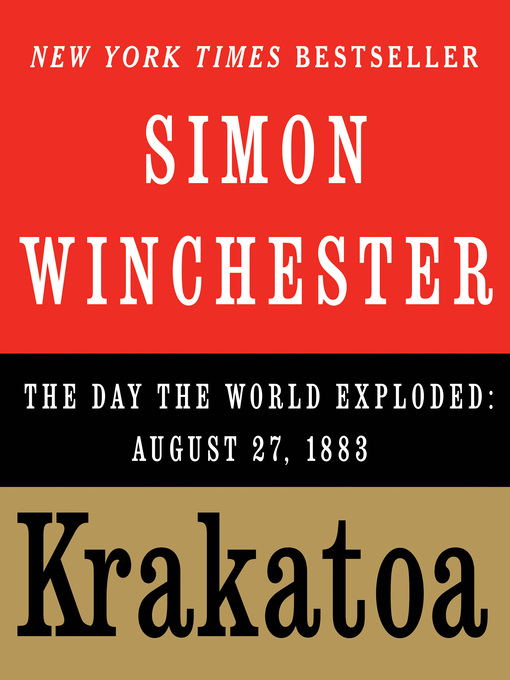
Krakatoa

The Day the World Exploded: August 27, 1883

Audiobook
1 of 1 copy available

The bestselling author of The Professor and the Madman and The Map That Changed the World examines the enduring and world-changing effects of the catastrophic eruption off the coast of Java of the earth's most dangerous volcano — Krakatoa.

The legendary annihilation in 1883 of the volcano-island of Krakatoa — the name has since become a byword for a cataclysmic disaster — was followed by an immense tsunami that killed nearly forty thousand people. Beyond the purely physical horrors of an event that has only very recently been properly understood, the eruption changed the world in more ways than could possibly be imagined. Dust swirled round die planet for years, causing temperatures to plummet and sunsets to turn vivid with lurid and unsettling displays of light. The effects of the immense waves were felt as far away as France. Barometers in Bogotá and Washington, D.C., went haywire. Bodies were washed up in Zanzibar. The sound of the island's destruction was heard in Australia and India and on islands thousands of miles away. Most significant of all — in view of today's new political climate — the eruption helped to trigger in Java a wave of murderous anti-Western militancy among fundamentalist Muslims: one of the first outbreaks of Islamic-inspired killings anywhere.

Simon Winchester's long experience in the world wandering as well as his knowledge of history and geology give us an entirely new perspective on this fascinating and iconic event as he brings it telling back to life.

  • Creators

  • Publisher

  • Awards

  • Release date

  • Formats

  • Languages

  • Reviews

    • AudioFile Magazine
      If you're looking for drama, you'll certainly find it here. With a volcanic explosion heard 3,000 miles away and a related tsunami that killed close to 40,000 people, there's plenty of excitement for the thrill-seeker. Win-chester, author of the bestselling THE PROFESSOR AND THE MADMAN, adroitly juggles a plethora of subjects, from the Dutch spice trade in colonial Java to the science of tectonic plates, creating a fascinating look at one of history's most cataclysmic disasters. Despite his BBC tone, Winchester manages a dry and ironic delivery, very much in keeping with his writing style. But the main point of interest when the dust has settled is the far-flung ramifications of this eruption upon world events. This is a winner. D.G. Winner of AudioFile Earphones Award; 2004 Audie Award Finalist (c) AudioFile 2003, Portland, Maine
    • Publisher's Weekly

      Starred review from March 10, 2003
      An erudite, fascinating account by one of the foremost purveyors of contemporary nonfiction, this book chronicles the underlying causes, utter devastation and lasting effects of the cataclysmic 1883 eruption of the volcano island Krakatoa in what is now Indonesia. Winchester (The Professor and the Madman; The Map That Changed the World) once again demonstrates a keen knack for balancing rich and often rigorous historical detail with dramatic tension and storytelling. Rather than start with brimstone images of the fateful event itself, Winchester takes a broader approach, beginning with his own viewing of the now peaceful remains of the mountain for a second time in a span of 25 years—and being awed by how much it had grown in that time. This nod to the earth's ceaseless rejuvenation informs the entire project, and Winchester uses the first half of the text to carefully explain the discovery and methods of such geological theories as continental drift and plate tectonics. In this way, the vivid descriptions of Krakatoa's destruction that follow will resonate more completely with readers, who will come to appreciate the awesome powers that were churning beneath the surface before it gave way. And while Winchester graphically illustrates, through eyewitness reports and extant data, the human tragedy and captivating scientific aftershocks of the explosion, he is also clearly intrigued with how it was "a demonstration of the utterly confident way that the world, however badly it has been wounded, picks itself up, continues to unfold its magic and its marvels, and sets itself back on its endless trail of evolutionary progress yet again." His investigations have produced a work that is relevant to scholars and intriguing to others, who will relish it footnotes and all.

    • Library Journal

      December 1, 2002
      Everyone's favorite geologist takes on a volcanic eruption that killed nearly 40,000 people and changed the climate for years.

      Copyright 2002 Library Journal, LLC Used with permission.

    • Library Journal

      August 1, 2003
      In 1883, Krakatoa, the largest volcanic eruption in modern history, killed thousands, caused worldwide climactic changes, and induced massive political and social upheaval in Java. Noted science writer Winchester tackles this interesting subject in his usual eclectic and charming manner. Geology, history, biology, and politics all play a role. From 16th-century European merchant invaders to 19th-century evolutionary theorist Henry Wallace to 20th-century magnetic pole data from Greenland, the author has compiled and organized massive amounts of data. The result is a fascinating picture of the Krakatoa disaster, from causes to consequences. Competently read by the author (with an occasional chuckle in his voice), Krakatoa would be an excellent choice for moderate to large public library collections.-I. Pour-El, Des Moines Area Community Coll., Boone, IA

      Copyright 2003 Library Journal, LLC Used with permission.

    • Booklist

      Starred review from February 1, 2003
      Winchester is a teacher to the world. Among his previous books are the best-selling " The Professor and the Madman" (1998) and " The Map That Changed the World "(2001), in which he taught us all about the " Oxford English Dictionary" and the world's first geological map, respectively. What's on his mind now? Sit back and learn, for this eloquent British writer submits a fascinating account of the cataclysmic explosion of the East Indian volcanic island of Krakatoa in 1883. The destruction was phenomenal, due primarily to the sea waves created by the explosion-"the most violent explosion ever recorded and experienced by modern man"-which swept away nearly 200 villages on neighboring islands. Krakatoa evaporated, "blasted out of existence"-simply a space left in the sea. Of course, this wouldn't be a book by Winchester if he simply narrated the events of the eruption, exciting as the details are; no, he gives us a wealth of further information, setting the incident within the contexts of general volcanic behavior, plate tectonics, Dutch rule in the East Indies, and the region's flora and fauna. In the wake of Krakatoa came the recognition that natural events in one place can greatly affect those in far-distant places, hardly news to us but news nonetheless back then. All readers, science-prone or not, will be delighted by this experience-expanding book.(Reprinted with permission of Booklist, copyright 2003, American Library Association.)

    • School Library Journal

      October 1, 2003
      Adult/High School-This expansive chronicle of a geologically unstable hot spot between the islands of Java and Sumatra, scene of the cataclysmic 1883 eruption of Krakatoa, conveys not only a wealth of scientific detail related to the event, but also addresses long-term ramifications for the social, political, economic, and religious fabric of the region. During the volcano's final 20 hours and 56 minutes, sounds from Krakatoa's eruption were heard 2968 miles away, and the air shock waves it created were recorded circling the globe seven times. Ultimately, the "six cubic miles of rock" that had been the island vanished. Winchester points out that Krakatoa was the first catastrophe to occur "after the establishment of a worldwide network of telegraph cables" that enabled news of the devastation to be transmitted with heretofore unheard of speed. Scientific investigations continue to this day, with particular watchfulness over Anak Krakatoa (literally, "son of Krakatoa"), an active volcanic island located in the same spot, which began forming in 1927-1930 and is growing in height at a rate of 20 feet per year. The author cuts a broad swath as he transitions among topics as diverse as plate tectonics, the 16th-century Dutch-colonial spice trade, and the seeds of radical Islamic fundamentalism in Indonesia, but the telling is masterful and conscientious readers are rewarded by his elucidation of complex interrelationships.-Lynn Nutwell, Fairfax City Regional Library, VA Graphic Novels

      Copyright 2003 School Library Journal, LLC Used with permission.

    • Library Journal

      Starred review from April 1, 2003
      When Krakatoa, an island volcano off the coast of Java, erupted on August 27, 1883, it spewed debris 24 miles into the air, was heard 4000 miles away, and caused barometers throughout Europe to go berserk. Tsunamis destroyed 165 villages and killed 36,417 people, but as recounted by Winchester (The Map That Changed the World) in this fascinating history, the eruption's devastating effects were not only environmental (dust circled the globe for years) but also political. Winchester notes that prior to the eruption, a Javanese Muslim priest had predicted that floods, blood-colored rain, volcanic eruptions, and death would precede the beginning of a holy war against the infidel. The resulting rash of murderous attacks by fundamentalist Muslims against European colonists living in their midst, he argues, was also a reaction to the escalating threat of Western imperialism into Muslim territory. As one of the first such Muslim outbreaks against Western control, it stands as a cautionary message for the future, along with the disturbing fact that Anak Krakatoa ("child of Krakatoa") has grown 500 feet in 25 years in one of the world's most active and dangerous volcanic regions. As a rich blend of science and history, this book is highly recommended for most public and academic libraries. [Previewed in Prepub Alert, LJ 12/02.]-Gloria Maxwell, Penn Valley Community Coll. Lib., Kansas City, MO

      Copyright 2003 Library Journal, LLC Used with permission.

Formats

  • OverDrive Listen audiobook

Languages

  • English

Loading